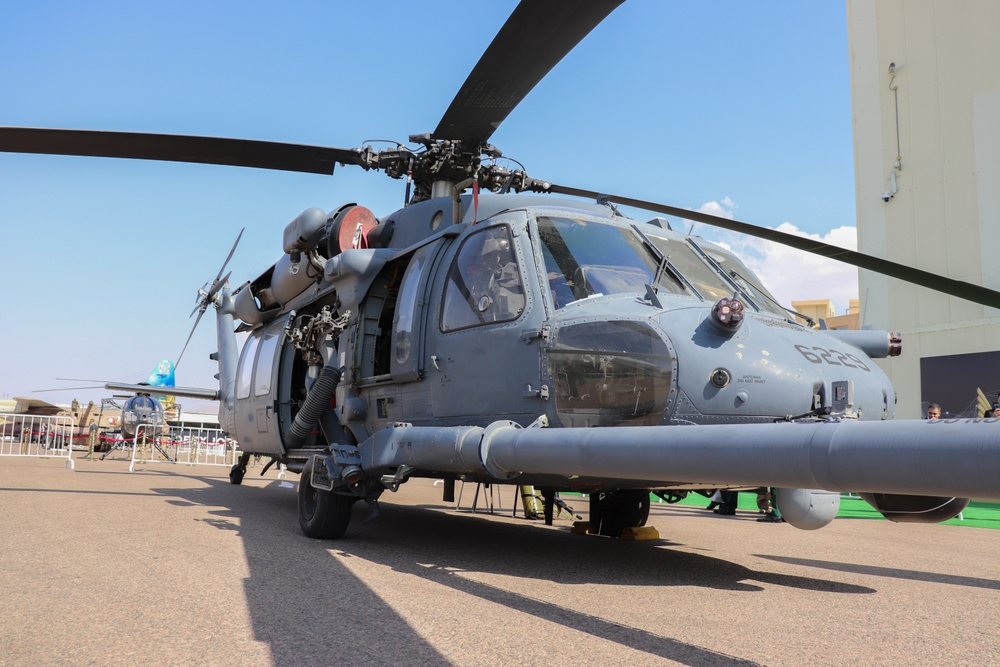
The HH-60W Jolly Green II is the Air Force’s dedicated combat-rescue helicopter replacing the HH-60G Pave Hawk. Its purpose is personnel recovery: reaching isolated people, supporting their rescue and bringing them out. The familiar H-60 outline hides a mission-specific fuel system, communications and defensive equipment.
Reviewed November 15, 2026. Figures below retain the labels used by their sources; range is not a guaranteed combat radius.
HH-60W specifications at a glance
| Characteristic | Published figure |
|---|---|
| Rotor diameter | 53.6 ft (16.34 m) |
| Length | 64.7 ft (19.72 m) |
| Height | 16.7 ft (5.1 m) |
| Operating weight | 22,500 lb |
| Speed | 176 mph / 153 knots indicated at sea level |
| Range | 690 miles / 599 nautical miles; air-refuelable |
| Ceiling | 20,000 ft |
| Armament | Two 7.62 mm miniguns or two .50-caliber machine guns |
Source: Davis-Monthan HH-60W fact sheet. “Operating weight” should not be relabeled as maximum takeoff weight, and indicated airspeed is not a cruise-speed guarantee. Do not combine the fastest speed, largest load and longest range from separate tables into one mission claim.
Range, combat radius and the fuel comparison
Range describes distance flown under a set of assumptions. A recovery mission must also allow for the outbound leg, time locating or recovering survivors, the return leg and reserves. Simply dividing a published range by two does not establish a useful combat radius. Wind, hover time, equipment and the recovery location change the problem.
Lockheed Martin’s first-flight announcement identifies the UH-60M Black Hawk as the production foundation and says the HH-60W’s internal fuel tank capacity is nearly twice that of the UH-60M. That is the specific comparison; it should not be presented as twice the capacity of every HH-60G configuration. The first flight took place May 17, 2019.
Aerial refueling expands the options available to mission planners, but it requires a suitable tanker, rendezvous and support plan. It does not make endurance unlimited or remove the need for reserves. For a broader comparison of distance and payload tradeoffs, see our military transport aircraft guide.
Who flies the HH-60W?
The Air Force Reserve’s February 2024 delivery report describes an aircrew of two pilots and two special-mission aviators. Rescue personnel and the people being recovered are additional to that baseline. A crew count is not a statement of passenger or litter capacity for every configuration.
What changes from the Pave Hawk?
The Air Force’s combat-ready announcement describes improvements to communications, navigation and defensive systems, plus the GAU-21 .50-caliber weapon capability. Those upgrades support the rescue mission; they do not make the aircraft an attack helicopter or guarantee survival against every threat.
The distinction matters when comparing aircraft. The UH-60M is the design foundation, the HH-60G Pave Hawk is the predecessor being replaced, and Jolly Green II is the HH-60W’s name. Calling the new aircraft “HH-60W Pave Hawk” mixes the two rescue variants.
Is the HH-60W operational?
Yes. The Air Force declared it combat ready on October 4, 2022, meaning it met Air Combat Command’s minimum combat-search-and-rescue requirements. That milestone was not a claim that every upgrade or fleet transition had finished.
The Air Force also documented the 56th Expeditionary Rescue Squadron’s arrival at Camp Lemonnier on June 10, 2026. Its helicopters were transported aboard a C-5 and integrated with regional rescue organizations. This is a dated example of operational fielding, not a live inventory or a claim about current deployment locations.
How to compare HH-60W figures accurately
- Keep the aircraft variant and source date beside each figure.
- Separate operating weight, maximum weight and useful payload.
- Distinguish indicated airspeed from cruise and maximum speeds.
- Check whether a distance is range, radius or an aerial-refueled mission.
- Treat procurement plans, deliveries and aircraft available for operations as different counts.
Stay in the loop
Get the latest aircraft insider updates delivered to your inbox.